Anambra's Erosion and Bad Roads Crisis: Six Months of Warnings, Collapsing Roads and Threatened Homes
The original publication time was not recorded.
Community report: includes residents’ accounts; attribution and verification notes appear in the article.
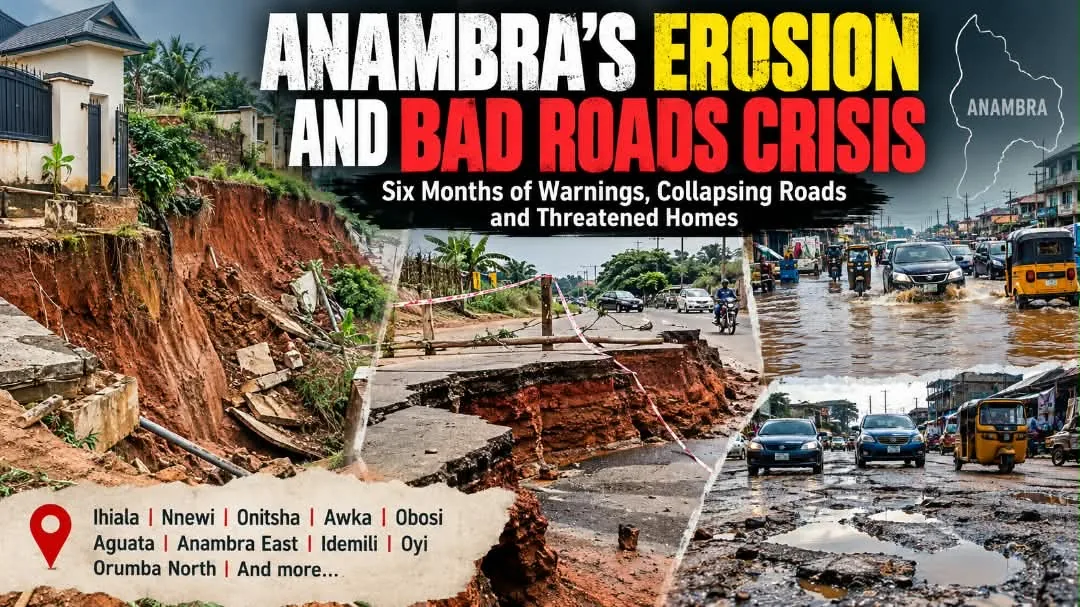
From Ihiala to Awka, Onitsha to Nnewi, communities across Anambra State are confronting deteriorating roads, expanding erosion gullies and persistent flooding. Anambra Socials reviews dozens of locations brought to public attention and asks a pressing question: How many more warnings must residents issue before lasting solutions arrive?
A State Under Threat
Across Anambra State, roads that once connected communities are becoming increasingly difficult to navigate. In some locations, erosion has eaten into roadways, leaving dangerous craters. Elsewhere, residents are watching helplessly as expanding gullies approach their homes, threatening properties built through years of hard work.
For months, Anambra Socials has documented these conditions through videos, photographs, eyewitness accounts and reports from concerned residents.
The recurring message is troubling: infrastructure is deteriorating in several communities, while the scale of the problems threatens to overwhelm temporary interventions.
Our review of reporting records covering April to October 2026 identifies at least 18 erosion-related locations and 20 bad-road locations, with some sites appearing in both categories. These figures are preliminary, not an exhaustive inventory of every affected location in Anambra State.
The evidence nevertheless points to a serious infrastructure and environmental challenge requiring urgent attention.
Ihiala: Where Erosion Is Threatening Homes and Cutting Off Roads
Among the most alarming reports received by Anambra Socials are those from Ihiala Local Government Area.
At Ndiezike Road, Umudara, a resident watched as erosion destroyed his perimeter fence, gate and septic tank. Video footage showed the expanding erosion approaching the main residential building.
Workers were reportedly brought in to salvage the fallen gate, but the greater concern remained the possibility of losing the entire house.
For the property owner, this is not simply an environmental statistic. It represents the potential loss of a lifetime's investment.
Another disturbing case emerged along the road opposite the Nigerian Starch Mill, leading towards Eziama community in Uli.
A massive erosion crater had developed along the road, making passage extremely difficult for vehicles and pedestrians.
The Oluoha–Umuezeawala Road, also in Ihiala LGA, was similarly reported to be in a severely deteriorated and virtually impassable condition.
These incidents raise serious questions about erosion control, drainage planning and the prioritisation of vulnerable communities.
Nnewi–Ukpor Road: A Disaster Residents Warned About
The deterioration of the Nnewi–Ukpor Road illustrates the consequences of allowing a developing infrastructure problem to worsen.
Anambra Socials had previously highlighted the dangerous condition of the road, warning about erosion and the risk to motorists.
Temporary sand filling was reportedly carried out, but it failed to provide a lasting solution.
Weeks later, the situation deteriorated further, leaving a section of the road severed.
Residents and concerned individuals resorted to placing warning materials around the damaged section to prevent unsuspecting motorists from driving into the danger.
One report described a motorcycle falling into the damaged area before additional warning measures were installed.
This raises an important question: Why must a road deteriorate to the point of becoming impassable before comprehensive intervention is considered?
Preventive maintenance is generally less disruptive and can be significantly less expensive than rebuilding infrastructure after extensive damage.
Idemili: Erosion Threatens Roads, Markets and Residential Communities
The Idemili axis has featured repeatedly in reports of erosion and road deterioration.
Along the Nnobi–Ideani Road, erosion was reported to be advancing towards the roadway, raising concerns about a possible collapse if left unchecked.
In Obosi, reports concerning the Ugama/Ugamuma area highlighted erosion threatening residential buildings, while another report from the Electrical Market described erosion advancing towards commercial premises.
The Nkpor–Obosi axis also featured reports of erosion and landslide threats near residential properties.
Other affected locations identified in our reporting include Umuagu in Nnobi and Oraukwu Road near Ezigbo River.
The implications extend beyond damaged infrastructure.
When erosion threatens a marketplace, it also threatens traders' livelihoods, customers' safety and the economic activities that sustain entire households.
When access roads deteriorate, the consequences can include increased transportation costs, disrupted trade and reduced access to essential services.
Awka: Bad Roads in the State Capital
One might expect the capital city of Anambra State to demonstrate a higher standard of road maintenance.
However, Anambra Socials has documented significant road problems within Awka.
A particularly concerning example was Zik's Avenue and the Amaku Road corridor leading to Chukwuemeka Odumegwu Ojukwu University Teaching Hospital (COOUTH).
A resident's video showed severely damaged road sections, with claims that residents had resorted to using discarded materials, including mattresses and rags, to fill potholes.
The condition raised obvious concerns about the movement of ambulances, patients, healthcare workers and other road users.
Following sustained public complaints, the Awka Capital Territory Development Authority (ACTDA) announced the commencement of reconstruction works along the road.
This intervention deserves recognition.
However, it also highlights the importance of addressing infrastructure problems before they become the subject of widespread public outrage.
Elsewhere in Awka, Ngozika Estate Road 16 and the Unizik Junction area featured in reports of flooding and deteriorating road conditions.
The Isiagu–Nibo axis also experienced serious flooding incidents that required emergency rescue operations.
For a rapidly developing capital city, effective drainage and regular road maintenance must remain central planning priorities.
Onitsha: Commercial Activities Meet Failing Infrastructure
Onitsha is one of the most commercially important cities in southeastern Nigeria.
Yet several roads serving its commercial and residential communities have featured in Anambra Socials reports.
At Modebe Road, a major sinkhole reportedly damaged a substantial portion of the roadway, creating serious safety concerns.
A subsequent intervention by Hon. James Ibezimako Akpudo involved filling the damaged section with stones and blocks.
While such action may temporarily reduce immediate danger, permanent engineering solutions are necessary where the underlying problem remains unresolved.
The Onitsha–Owerri Road has also featured in reports of damaged road surfaces, potholes and flooding.
In Fegge, multiple damaged road sections were highlighted, including routes used by traders and commuters accessing important commercial areas.
At the Electrical Market in Obosi, blocked gutters and accumulated refuse raised concerns about inadequate drainage maintenance.
Poor drainage, when combined with heavy rainfall, can accelerate pavement deterioration and contribute to erosion.
Aguata, Nanka and Other Communities: The Crisis Extends Beyond Major Cities
In Aguluezechukwu, Aguata Local Government Area, a resident raised concerns about erosion allegedly caused by the improper channelling of drainage along the Ekwulobia–Uga Road.
The allegation requires technical investigation, but it highlights a critical issue.
Road construction without properly designed drainage can transfer flooding and erosion problems from one location to another.
At Obiuno in Igbo-Ukwu, erosion was reported to be threatening homes and livelihoods.
Nanka, in Orumba North, also featured in reports of major erosion damage, including a crater threatening road access and nearby properties.
Other reported locations include Nkwele Ezunanka in Oyi LGA, Obele Mmili in Nsugbe, and the Umueri–Aguleri Road in Anambra East.
Along the Umueri–Aguleri corridor, erosion at the road edge raised particular concerns about motorists travelling at night without adequate warning signs.
These examples demonstrate that the problem is not confined to one local government area or one section of the state.
Students, Patients and Traders Are Paying the Price
Beyond the visible destruction, deteriorating infrastructure carries significant human and economic consequences.
At Okofia in Nnewi, a student of the College of Health Sciences appealed for government intervention over the poor condition of access roads serving the institution.
Video footage showed difficult pedestrian conditions, including muddy surfaces and waterlogged sections.
Along the Achalla–Igbariam access corridor, damaged roads similarly raised concerns about movement between communities.
In Awka, the road serving COOUTH illustrated the possible consequences for healthcare access.
Across commercial centres such as Onitsha, road deterioration can delay deliveries, increase vehicle maintenance costs and disrupt business activities.
For affected residents, the crisis is not simply about potholes or erosion gullies.
It is about the ability to get to school, reach a hospital, conduct business and return home safely.
Government Interventions: Progress, But Are They Enough?
It would be inaccurate to suggest that every reported location has been completely ignored.
Anambra Socials has also documented government interventions and community-led responses.
These include the commencement of reconstruction works on Amaku Road in Awka, temporary repairs on Modebe Road, reported erosion-control activity at Obele Mmili in Nsugbe and emergency measures at other threatened locations.
Such interventions are welcome.
However, the central concern is whether these measures provide durable solutions.
Filling a dangerous crater may temporarily restore access, but it does not necessarily address the drainage or soil instability that created the problem.
Similarly, repairing a damaged road without investigating the causes of repeated deterioration may only postpone the next failure.
Public authorities should therefore provide clear information on the scope of interventions, the engineering solutions adopted, project costs, completion timelines and long-term maintenance plans.
What Anambra State Must Do
The Anambra State Government, relevant federal agencies and local government authorities must treat erosion control and road maintenance as urgent, coordinated responsibilities.
An effective response should include:
- A comprehensive erosion and road-condition audit: Identify vulnerable roads, expanding gullies, threatened residential properties and drainage failures across all 21 local government areas.
- Emergency protection of high-risk locations: Install visible warning signs, barriers and appropriate traffic restrictions around dangerous craters, collapsed road sections and unstable edges.
- Permanent drainage and erosion-control solutions: Prioritise engineering assessments and lasting remediation rather than relying solely on temporary filling.
- Greater accountability for road construction: Investigate premature road deterioration and determine whether design, materials, drainage, maintenance or construction quality contributed to the damage.
- Transparent public updates: Publish intervention schedules, contractor information, project milestones and completion reports so residents can monitor progress.
- Protection for vulnerable households: Establish urgent response procedures for residents whose homes face immediate threats from expanding erosion.
These recommendations are not extraordinary demands.
They are basic expectations of responsible infrastructure management.
The Bigger Question: How Many More Roads Must Collapse?
Anambra State is not without resources, professional expertise or institutional capacity.
The state has engineers, environmental specialists, planning authorities and public agencies responsible for infrastructure development.
What residents need is a coordinated response that matches the seriousness of the problem.
When a road begins to crack, action should not wait until it collapses.
When erosion threatens a building, residents should not have to watch helplessly until their property disappears.
When a newly reconstructed road begins to fail, there should be an independent assessment of what went wrong.
And when communities repeatedly raise concerns about dangerous infrastructure, those warnings should trigger timely inspections and appropriate intervention.
The growing collection of videos and reports documented by Anambra Socials represents more than a catalogue of damaged roads.
It is a record of communities asking to be heard.
Our Commitment at Anambra Socials
Anambra Socials will continue to document erosion sites, deteriorating roads, flooding incidents and government responses across Anambra State.
We will also acknowledge completed interventions and improvements wherever credible evidence is available.
Our objective is not simply to highlight problems, but to encourage accountability, timely action and lasting solutions.
Every collapsed road was once a road that could be used. Every expanding erosion gully began somewhere. Every threatened home represents a family facing the possibility of devastating loss.
The warnings are already there.
The question now is whether those responsible will act before the next preventable disaster.
Have you noticed a dangerous erosion site, collapsed road or serious drainage problem in your community?
Send Anambra Socials the location, local government area, recent photographs or videos, and any information about previous complaints or government interventions.
Together, we can build a more comprehensive picture of Anambra's infrastructure challenges and continue demanding practical solutions.
Anambra Socials | Reporting Our Communities. Amplifying Our Voices.
Editor's note: This article is based on a preliminary compilation of Anambra Socials reporting records available up to 9 October 2026. Some incidents are based on residents' accounts and allegations requiring independent technical confirmation. The locations listed should not be interpreted as a verified inventory of all erosion and road damage in the state, and repair statuses may have changed since the original reports.
Source review and subsequent reporting
This review compiles Anambra Socials’ earlier reporting records. The stated location counts remain a preliminary editorial compilation, not a government survey or an independently audited register. Conditions and repair status can differ between the original recording and the date a reader visits a site.
There is independent reporting relevant to some of the locations. The Sun’s July 2026 account documents residents’ complaints and official engagement in Umusiome, Nkpor. It should not be taken as confirmation of every separate Nkpor location in this compilation.
The government’s 15 October account of its contractors’ meeting also records a directive to inspect and remedy defects. That announcement provides an official response to road-quality concerns; it does not establish that all sites in this review have been repaired.
For more recent evidence, see our Uli follow-up and Agulu–Nnewi roadworks report. Each has its own date, footage and verification limits.
Sources and reporting basis
- The Sun, 29 July 2026: Umusiome erosion concerns
- Anambra State Government, 15 October 2026: road-contractor response
External reports provide the context identified above; they do not independently verify every statement in submitted footage.
Editorial update, 19 October 2026: Added a source review, official response and links to dated follow-ups without presenting the preliminary location counts as a verified statewide inventory.
Categories: Roads and Infrastructure, Environment, Community Voices
Related Articles
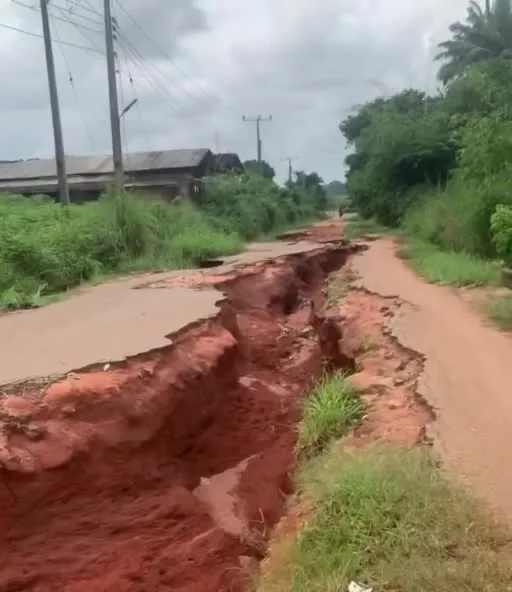
Erosion Splits Starch Mill–Eziama Road in Uli as New Footage Renews Calls for Intervention
New footage shows a deep erosion gully splitting Starch Mill–Eziama Road in Uli, Ihiala LGA, following Anambra Socials’ earlier report.
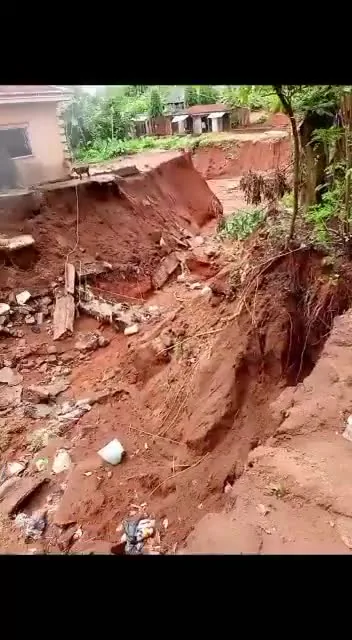
Umusiome Nkpor Erosion: Two Houses Reportedly Lost, More Homes Under Threat
Residents raise the alarm over erosion at Ochiaya, Buzuzu Street, Umusiome, Nkpor, where two houses are reportedly lost and more homes face danger.
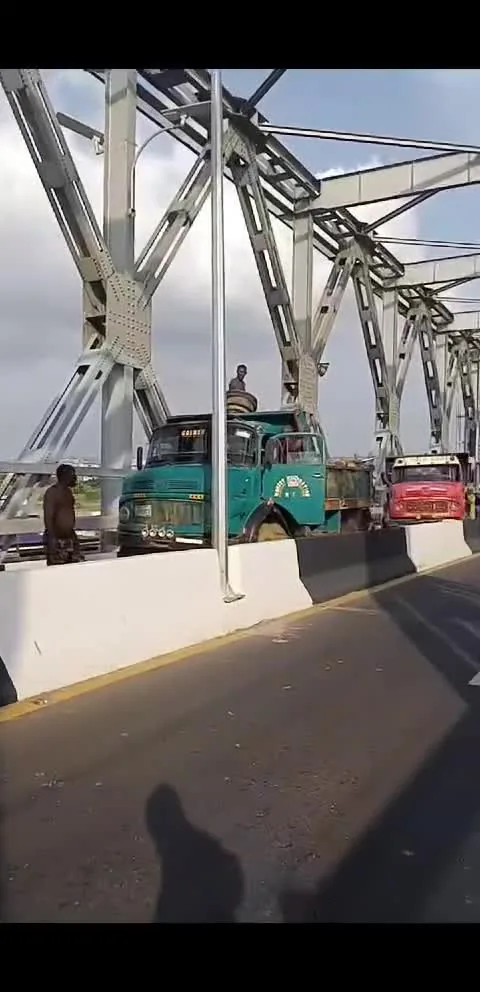
First Niger Bridge Gridlock After Reported Trailer Breakdown Renews Emergency-Response Questions
Supplied footage shows queued trucks on the First Niger Bridge, renewing questions about median barriers, towing arrangements and emergency access.