
Onitsha Main Market Reconstruction: Safety Questions and the Evidence Available
Commentary: this article combines reporting with editorial analysis.
Featured media: Still from supplied footage identified as Onitsha Main Market. The video bears the watermark @AMERICANMANCOMEDIAN; original recorder and filming date have not been independently authenticated.
Watch video on its dedicated page
ONITSHA, Anambra State. Footage supplied to Anambra Socials shows extensive steel framework taking shape above busy trading areas identified as Onitsha Main Market, prompting questions about construction quality and public safety during the redevelopment.
The accompanying commentary questions whether design approval is sufficient assurance that materials and construction meet the intended requirements. This is a legitimate accountability question, but the footage does not establish that the materials are inferior or that the structure is unsafe.
Watch the supplied footage
The recording shows rows of steel members, roofing work and people trading or moving near the construction area. It does not provide material certificates, measured dimensions, foundation information or inspection results.
What the government has said
In an official report published on 5 August 2026, Housing Commissioner Henry Arize assured traders that reconstruction would follow approved architectural and engineering drawings.
The account describes a meeting on 3 August with representatives of Niger Line and Johnson Street Line. Arize said work inconsistent with approved plans would not be tolerated. These are published government assurances, not an independently examined set of inspection records.
The state’s 25 June project announcement recorded a site handover to contractors the previous day and listed structural steel, roofing, cladding and supporting facilities among the redevelopment components.
An official procurement notice for structural steel works at Gwongwolo I and Lagos Line provides further project background. A tender notice does not demonstrate that each part of the work shown in this recording has been inspected or accepted.
Recent reporting includes favourable professional comments
The Razor’s recent inspection report quotes Prof. Henry Aginam expressing satisfaction with the materials and professional involvement. It also identifies Prof. Akaolisa Ezeadi as a COREN representative and reports his statement that monitoring would continue until completion.
Those reported comments are relevant and should be considered alongside the concerns. Anambra Socials has not obtained the underlying inspection reports or a formal COREN certificate, and does not present the comments as a blanket guarantee covering every construction stage or location.
Design approval and construction verification
Design documents describe what should be built. Establishing whether the work matches those requirements calls for evidence about the materials and workmanship actually delivered.
As general engineering context, SteelConstruction.info’s explanation of steelwork specifications distinguishes design assumptions from requirements for materials, fabrication, erection and quality management. It explains that the completed work must satisfy the assumptions on which the design rests.
That UK industry guidance illustrates the principle. It is not a finding about this project or a statement that a particular British standard is legally required for the Onitsha works.
Likewise, the apparent slenderness or spacing of steel members in a phone video is not sufficient to assess their capacity. A qualified engineer would need the relevant design and site evidence before reaching a conclusion.
What greater transparency could provide
The responsible authorities could strengthen public confidence by explaining which professionals supervise the works, which inspections and material checks have been completed, and how traders and customers are protected during each construction stage.
A published summary of quality-control findings, any corrective work and the process for accepting completed sections would be more useful than asking viewers to decide safety from appearance alone. An independent review could also help resolve specific, documented concerns.
These are recommendations for transparency, not a claim that the checks have not occurred. Modernisation and public safety should advance together, with progress assessed against evidence rather than either reassurance or criticism alone.
For related coverage, read our report on questions raised about Bright Street roadworks. Readers with inspection records or an official response can contact Anambra Socials.
Reporting note
This is commentary by Anambra Socials based on supplied footage and the linked sources reviewed on 28 October 2026. No independent structural inspection, material testing or review of the project’s complete drawings and quality records has been conducted for this article. The recording cannot establish structural failure, defective materials or compliance on its own. The government’s August assurances and the later reported professional comments are presented with their respective contexts.
Update, 30 October: a dated government progress claim
The government’s report of 27 October attributes a figure of more than 72 per cent completion and a December 2026 target to Information Commissioner Law Mefor.
This supplies a dated progress claim. It does not supply material test results or certify the safety of the structure shown in the video. A completion percentage and a structural acceptance record answer different questions. The coverage tracker records that distinction for future comparisons.
Categories: Roads and Infrastructure, Business and Markets, Opinion
Related Articles
Kingsley Ubani Questions Okey Ezeobi’s Remarks and Anambra’s Road Record
In this opinion piece, Kingsley Ubani criticises remarks attributed to Anambra Works Commissioner Okey Ezeobi and questions the state’s road projects and Ekwulobia flyover timeline.
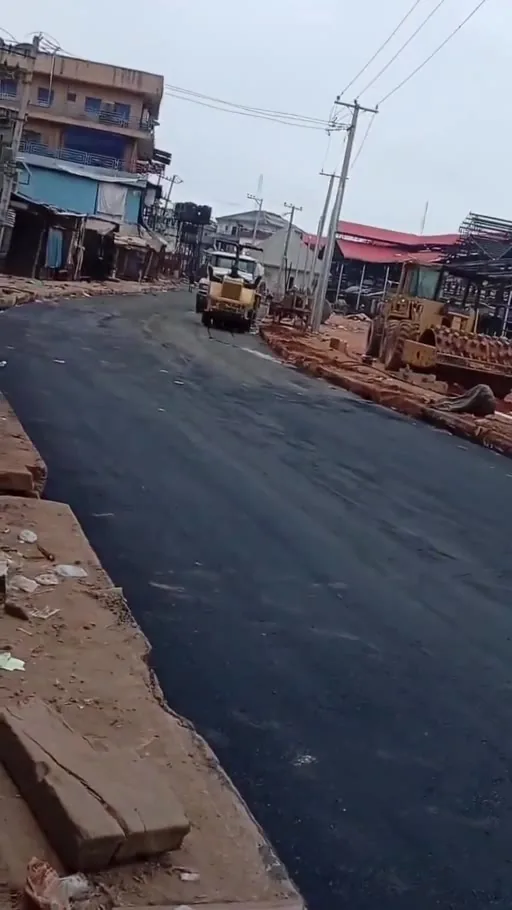
Bida-to-Waterside Road Asphalted at Onitsha Main Market
New footage shows fresh asphalt on the Bida-to-Waterside road at Onitsha Main Market as redevelopment work continues.

Soludo, Where Are the Trains? Anambra’s Unfulfilled Promises as Governor Turns Presidential Campaign Coordinator
Nnamdi Mezue examines Anambra’s outstanding railway, shopping mall, power, water, erosion, tourism and dry port commitments as Soludo takes on a presidential campaign role.